



ghcrawl is a local-first GitHub issue and pull request crawler for maintainers.

Install the published CLI package:
npm install -g ghcrawlThat package exposes the ghcrawl command directly.
If you are working from source or maintaining the repo, use CONTRIBUTING.md.
Normal ghcrawl use needs both:
- a GitHub personal access token
- an OpenAI API key
GitHub is required to crawl issue and PR data. OpenAI is required for embeddings and the maintainer clustering and search workflow. If you already have a populated local DB you can still browse it without live keys, but a fresh sync + embed + cluster or refresh run needs both.
ghcrawl init
ghcrawl configure
ghcrawl doctor
ghcrawl refresh owner/repo
ghcrawl tui owner/repo
ghcrawl init runs the setup wizard. It can either:
- save plaintext keys in
~/.config/ghcrawl/config.json - or guide you through a 1Password CLI (
op) setup that keeps keys out of the config file
ghcrawl refresh owner/repo is the main pipeline command. It pulls the latest open GitHub issues and pull requests, summarizes changed items only when the active embedding basis depends on summaries, refreshes vectors, and rebuilds the clusters you browse in the TUI.
Upgrading to this release changes the local vector and cluster pipeline:
- vectors now use a persistent
vectorlitesidecar index - the active vector is one vector per open thread
- old multi-row
document_embeddingsare removed after the first successful rebuild
For an existing repo, the one-time migration command is:
ghcrawl refresh owner/repoImportant notes:
refreshperforms the migration; plainsyncdoes not- with the default
title_originalbasis, the migration rebuilds vectors and clusters without running LLM summaries - if you switch to
title_summary,refreshalso runs the summarize step before embedding - after the first successful migration refresh, ghcrawl removes legacy embeddings, compacts the local DB, and rebuilds clusters from the current vectors
ghcrawl configure
ghcrawl doctor
ghcrawl refresh owner/repo
ghcrawl tui owner/reporefresh, sync, and embed call remote services and should be run intentionally.
cluster does not call remote services, but it is still time consuming. It now uses a persistent vectorlite index instead of exact in-memory scans, so large-repo rebuilds are materially faster, but still not instant.
clusters explores the clusters already stored in the local SQLite database and is expected to be the fast, read-only inspection path.
Every public command now supports both:
ghcrawl help refresh
ghcrawl refresh --help
For agent-facing and script-facing commands, prefer explicit machine mode:
ghcrawl configure --json
ghcrawl doctor --json
ghcrawl threads owner/repo --numbers 42,43,44 --json
ghcrawl clusters owner/repo --min-size 10 --limit 20 --sort recent --json
Contract notes:
doctorkeeps a human-readable TTY default unless you pass--json- JSON-oriented commands accept
--jsonexplicitly; current JSON-by-default behavior is still available as a compatibility path - machine payloads are written to
stdout - progress logs and error messages are written to
stderr - use
--config-path <path>to force a specific persisted config file - use
--workspace-root <path>to force.env.localand workspace-local DB discovery
ghcrawl refresh owner/repo
| User open issue/PR list modal | Refresh modal |
|---|---|
 |
 |
Press u to open the current user's issue and PR list modal. |
Press g to open the GitHub/embed/cluster refresh modal. |
| Closed members in a cluster | Fully closed cluster |
|---|---|
 |
 |
| Closed members stay visible in gray so overlap is still easy to inspect. | A cluster with no open members is grayed out as a whole until you hide closed items. |

Press l on wide screens to toggle the stacked layout with the cluster list on the left and members/detail stacked on the right.
Most users should run ghcrawl refresh owner/repo and let it do the full pipeline in the right order.
If you need tighter control, you can run the three stages yourself:
ghcrawl sync owner/repo     # pull the latest open issues and pull requests from GitHub
ghcrawl summarize owner/repo  # optional explicit summary refresh when using title_summary
ghcrawl embed owner/repo    # generate or refresh the single active vector per thread
ghcrawl cluster owner/repo  # rebuild local related-work clusters from the current vectors (local-only, but can take ~10 minutes on a ~12k issue/PR repo)
Run them in that order. If your embedding basis is title_summary, refresh automatically inserts the summarize stage before embed for you. With the default title_original basis, refresh does not summarize unless you run summarize explicitly.
First run:
ghcrawl init
ghcrawl doctor
init behavior:
- prompts you to choose one of two secret-storage modes:
plaintext: saves both keys to~/.config/ghcrawl/config.json1Password CLI: stores only vault and item metadata and tells you how to runghcrawlthroughop
- if you choose plaintext storage, init warns that anyone who can read that file can use your keys and that resulting API charges are your responsibility
- if you choose 1Password CLI mode, init tells you to create a Secure Note with concealed fields named:
GITHUB_TOKENOPENAI_API_KEY
GitHub token guidance:
- recommended: fine-grained PAT scoped to the repositories you want to crawl
- repository permissions:
Metadata: Read-onlyIssues: Read-onlyPull requests: Read-only
- if you use a classic PAT and need private repositories,
repois the safe fallback scope
doctor checks:
- config file presence and path
- local DB path wiring
- GitHub token presence, token-shape validation, and a live auth smoke check
- OpenAI key presence, key-shape validation, and a live auth smoke check
vectorliteruntime readiness- if init is configured for 1Password CLI but you forgot to run through your
opwrapper, doctor tells you that explicitly
Use configure to inspect or change the active summary model and embedding basis:
ghcrawl configure
ghcrawl configure --summary-model gpt-5.4-mini
ghcrawl configure --embedding-basis title_original
Current defaults:
- summary model:
gpt-5-mini - embedding basis:
title_original(title + original body) - vector backend:
vectorlite
Changing the summary model or embedding basis makes the next refresh rebuild vectors and clusters for that repo.
If you opt into title_summary, ghcrawl summarizes before embedding and uses title + dedupe summary as the active vector text. On openclaw/openclaw, that improved non-solo cluster membership by about 50% versus title_original, but it adds OpenAI spend. A first summarize of roughly 18k open issues and PRs in that repo typically costs about $15-$30 with gpt-5-mini; later refreshes are usually much cheaper because only changed items need summaries.
If you choose 1Password CLI mode, create a 1Password Secure Note with concealed fields named exactly:
GITHUB_TOKENOPENAI_API_KEY
Then add this wrapper to ~/.zshrc:
ghcrawl-op() {
  env GITHUB_TOKEN="$(op read 'op://Private/ghcrawl/GITHUB_TOKEN')" \
      OPENAI_API_KEY="$(op read 'op://Private/ghcrawl/OPENAI_API_KEY')" \
      ghcrawl "$@"
}
Then use:
ghcrawl-op doctor
ghcrawl-op refresh owner/repo
ghcrawl-op tui owner/repoThese commands are intended more for scripts, bots, and agent integrations than for normal day-to-day terminal browsing:
ghcrawl threads owner/repo --numbers 42,43,44 --json
ghcrawl threads owner/repo --numbers 42,43,44 --include-closed --json
ghcrawl author owner/repo --login lqquan --json
ghcrawl close-thread owner/repo --number 42 --json
ghcrawl close-cluster owner/repo --id 123 --json
ghcrawl clusters owner/repo --min-size 10 --limit 20 --json
ghcrawl clusters owner/repo --min-size 10 --limit 20 --include-closed --json
ghcrawl cluster-detail owner/repo --id 123 --json
ghcrawl cluster-detail owner/repo --id 123 --include-closed --json
ghcrawl search owner/repo --query "download stalls" --json
Use threads --numbers ... when you want several specific issue or PR records in one CLI call instead of paying process startup overhead repeatedly.
Use author --login ... when you want all currently open issue/PR records from one user plus the strongest stored same-author similarity match for each item.
By default, JSON list commands filter out locally closed issues/PRs and completely closed clusters. Use --include-closed when you need to inspect those records too.
Use close-thread when you know a local issue/PR should be treated as closed before the next GitHub sync catches up. If that was the last open item in its cluster, ghcrawl automatically marks the cluster closed too.
Use close-cluster when you want to locally suppress a whole cluster from default JSON exploration without waiting for a rebuild.
The main variable costs are summarization and embeddings. Embedding pricing is published by OpenAI here: OpenAI API pricing.
On a real local run against roughly 12k issues plus about 1.2x related PR and issue inputs, text-embedding-3-large came out to about $0.65 USD total to embed the repo. Treat that as an approximate data point for something like ~14k issue and PR inputs, not a hard guarantee.
For one-time summary migration planning on a repo around the size of openclaw/openclaw (~20k issues and PRs), ghcrawl configure reports these operator estimates using the April 1, 2026 USD pricing assumptions for this release:
gpt-5-mini: about $12 USD one timegpt-5.4-mini: about $30 USD one time
gpt-5-mini is the default to keep that migration cost lower. gpt-5.4-mini is available when you want higher-quality summaries and are comfortable with the higher one-time spend.
This screenshot is the reference point for that estimate:

This repo ships an installable skill at skills/ghcrawl/SKILL.md.
For installation and usage conventions, point users at vercel-labs/skills.
Install the CLI first, then install the skill:
npm i -g ghcrawl
npx skills add -g pwrdrvr/ghcrawl
The skill is built around the stable JSON CLI surface and is intentionally conservative:
- default mode assumes no valid API keys and stays read-only
- API-backed operations only become available after
ghcrawl doctor --jsonshows healthy auth - even then,
refresh,sync,embed, andclustershould only run when the user explicitly asks for them - JSON list commands hide locally closed issues/PRs and closed clusters by default unless
--include-closedis passed
ghcrawl doctor --json
ghcrawl refresh owner/repo
ghcrawl threads owner/repo --numbers 42,43,44 --json
ghcrawl clusters owner/repo --min-size 10 --limit 20 --sort recent --json
ghcrawl cluster-detail owner/repo --id 123 --member-limit 20 --body-chars 280 --json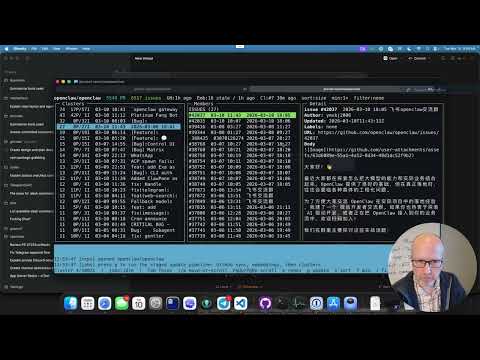
GitHub README links cannot force a new tab, but clicking the preview above will open the YouTube walkthrough from the repo page.
The agent and build contract for this repo lives in SPEC.md.
servestarts the local HTTP API only. The web UI is not built yet.synconly pulls open issues and PRs.- a plain
sync owner/repois incremental by default after the first full completed open scan for that repo syncis metadata-only by defaultsync --include-commentsenables issue comments, PR reviews, and review comments for deeper contextembeddefaults totext-embedding-3-largewithdimensions=1024embedmaintains one active vector per thread, stored in a persistentvectorlitesidecar indexembedstores an input hash per thread and will not resubmit unchanged text for re-embedding- the default embedding basis is
title + original body; useghcrawl configure --embedding-basis title_summaryif you want to summarize before embedding sync --sinceaccepts ISO timestamps and relative durations like15m,2h,7d, and1mosync --limit <count>is the best smoke-test path on a busy repositorytuiremembers sort order and min cluster size per repository in the persisted config file- the TUI shows locally closed threads and clusters in gray; press
xto hide or show them - on wide screens, press
lto toggle between three columns and a wider cluster list with members/detail stacked on the right - if you add a brand-new repo from the TUI with
p, ghcrawl runs sync -> summarize-if-needed -> embed -> cluster and opens that repo with min cluster size1+
By operating ghcrawl, you accept that you, and any employer or organization you operate it for, are fully responsible for:
- obtaining GitHub and OpenAI API keys through legitimate means
- monitoring that your use of this tool complies with the agreements, usage terms, and platform policies that apply to those keys
- storing those API keys securely
- any misuse, theft, unexpected charges, or other consequences resulting from those keys being exposed or abused
- monitoring spend and stopping or reconfiguring the tool if usage is higher than you intended
The creators and contributors of ghcrawl accept no liability for API charges, account actions, policy violations, data loss, or misuse resulting from operation of this tool.