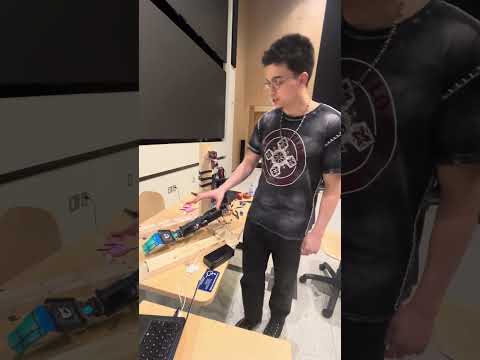
Many individuals who have lost the ability to use their hands face daily challenges in performing basic tasks, impacting their independence and quality of life. We wanted to build a solution that empowers users through technology, allowing them to interact with their environment effortlessly. Inspired by advancements in AI, robotics, and assistive devices, we developed Helping Hand—a bionic arm that responds to voice commands and visual input, enabling users to grasp objects intuitively.
Helping Hand is an AI-powered bionic arm that combines speech recognition and computer vision to assist users in picking up and interacting with objects. Users can simply say a command like "Pick up the red ball," and the arm will identify, approach, and grasp the object intelligently—pinching small items or gripping larger ones. This allows for seamless and adaptive control, enhancing accessibility for individuals with limited mobility.
- Speech Recognition: Processes voice commands to understand user intentions.
- Computer Vision: Uses object detection to identify and classify items in front of the arm.
- AI-Powered Grasping: Determines whether to grip with all fingers or pinch with two, based on the object's size and shape.
- Hardware Integration: Powered by servo motors, embedded microcontrollers, and machine learning models for smooth, adaptive movement.
- Real-Time Processing: Synchronizing speech input with visual recognition required optimizing performance for speed and accuracy.
- Object Detection Accuracy: Training the model to correctly identify and distinguish objects in varying lighting and backgrounds was challenging.
- Grip Precision: Ensuring that the arm grasps objects securely without dropping or crushing them required fine-tuning.
- Successfully integrated AI-driven speech and vision for natural interaction.
- Developed an adaptive grasping mechanism that adjusts based on object properties.
- Built a working prototype that demonstrates real-time object detection and response.
- Gained hands-on experience in computer vision, speech recognition, and robotics integration.
- Improved our understanding of human-centered design for assistive technology.
- Learned how to optimize AI models for real-time applications.
- Enhanced Object Recognition: Improving accuracy with better training datasets and edge-case handling.
- Customizable User Preferences: Allowing users to fine-tune grip strength and response settings.
- Wireless and Wearable Design: Exploring ways to make the arm lighter, more comfortable, and fully wireless.
- Integration with Smart Home Devices: Enabling Helping Hand to interact with voice assistants and home automation systems.